Here are my favorite places to get knitting patterns online. If you have any favorite places, please share them in the comments.
1. Knitty.com : Knitty is an online knitting magazine. Knitty offers free knitting patterns and informative articles. There are a variety of patterns from lots of knitters. You can even design a pattern and submit it. You never know, it might be featured in a future knitty.
2. Lion Brand Yarn : This is a yarn company, their yarns are affordable and can be found in stores like Michael's, Hobby Lobby, Wal-Mart, etc. They have a huge library of patterns available for free from their website. They also have some patterns available at a cost.
3. Interweave Knits/ Knitting Daily: Interweave Knits is a magazine, they also have a newsletter called knitting daily. Sometimes knitting daily has good information and patterns, other times, they send emails that are just advertisements for books they are publishing, or a special magazine. A good feature is that they usually take garments from their newly released magazine and try it on different body types to see how they fit people who aren't models.
4. Various Yarn Companies offer free patterns. This is a great way for them to show you all of the great things you can do with they yarn. Some of the yarn companies who offer (in my opinion) good patterns are: Berroco, Crystal Palace Yarns.
5. Local Yarn Shops: Many yarn shops offer free patterns. They also have patterns for sale and sometimes a pattern will be free with the purchase of a certain yarn. Ask the people working in the shop. They should be happy to help.
6. Your public library might be a good place to get knitting pattern books. The public library in my area offers many nice and new knitting books.
7. Stores like Michael's, Hobby Lobby, Wal-Mart, etc. often have pamphlets with free patterns available in the yarn area.
8. Blogs: Many bloggers write patterns and offer them for free or for sale on their sites. Look around and maybe your favorite blogger offers some. I don't have any yet, but am working on some to offer in the future.
9. Ravelry.com: This is an online knitting community. You have to be a member to access the site, but this is free and it is a good way to connect with fellow knitters and crafters.
10. Charity Knit alongs: The Knitting for Charity website seems like a good way to find charities to knit for. Other places might include calling your local hospital and asking if they accept hats, toys or blankets for new born babies, or sick children.
I hope this helps and If you have any other suggestions of where to find free knitting patterns, please leave a comment. Thanks!
Showing posts with label knitting tools. Show all posts
Showing posts with label knitting tools. Show all posts
Sunday, September 6, 2009


Thursday, December 11, 2008
The Golden Swatch
This post sort of compliments the one entitled "The Gauge Swatch" which was released on December 6th. I couldn't decide which way I wanted to present the information. The previous post gives a good description, this one tells a story about Swatches.
There once was a knitter who saw the most beautiful sweater in a magazine. It had cables in all the right places and the elegant way it hung on the model would be perfect for her son’s wedding. She only had a year until the wedding so she decided to get started soon. She went to her yarn shop and found a very soft Alpaca yarn, in a beautiful golden hank. This yarn wasn’t the exact yarn the pattern called for, but she fell in love with the Alpaca and knew it would be unbelievably gorgeous with the dress she planned on wearing to the wedding. She picked up the yarn (the amount called for and an extra skein, just in case) and told the sales lady all about her son’s wedding and how she wished she could see into the future. She wanted to know that the yarn would really be as perfect for the sweater as the picture she had in her mind. She wanted to make sure that when she washed it, the yarn would still have the same shine. She wanted to make sure that the pattern would look as glorious in the cables as the yarn used in the magazine’s version. That’s when the sales lady said “Why don’t you do a Gauge Swatch?” The knitter looked at her like she was speaking another language, being the kind of knitter who always knitted blankets and scarves and asked “What’s a Gauge Swatch?” The sales lady explained that a gauge swatch is a small representation of the knitted project. A swatch is usually knitted in the same pattern as the majority of the project. The Sales Lady then explained that the swatch is sort of like a crystal ball to see the future of your project. A swatch should answer most of your questions about what the finished project will look like and what it will do when it gets washed and blocked (stretched into shape).
The knitter bought the yarn and went home to make a Swatch. Her first attempt was definitely much bigger than the Gauge called for in the pattern, and she knew that washing it wasn’t going to make it any smaller. Then she switched to a smaller needle and the next swatch was just about perfect. She washed it and blocked it just as she had planned on washing and blocking the actual sweater. The swatch looked a little different, but it was even more beautiful. She measured the washed, blocked and dried swatch again and it was just the right size. Very excitedly, she started knitting her sweater. In just a few days she had made great progress on the back. She knitted every free minute that she could and in a few months, she had a sweater. She tried it on for her son and he was very impressed with her work. He was so impressed that he wanted her to make a white one for his fiancé’s going away outfit.
The knitter went to her favorite yarn shop and bought a beautiful silk and wool blend yarn. She knew that her future daughter in law would love the decadence of the silk. Ignoring the need for a Gauge Swatch, the knitter went home and started on the sweater. As she was working on the back of the sweater, she realized that something was not right. She knew that there was no way the huge sweater back would ever fit her petite future daughter in law. At this point, she realized that the yarn was a little thicker than the Alpaca she had used for her sweater and knitting a gauge swatch would’ve been a very good idea. She couldn’t bring herself to rip out the knitted sweater back, so she picked up another ball of yarn and some smaller needles and started on her gauge swatch. After she was finished, she took great care to wash the yarn exactly as the directions on the ball band told her. She was a little flabbergasted when she realized that the yarn seemed to have grown. It was bigger now and she knew she would have to go down at least another needle size. She went down two needle sizes, hoping that would give her the right gauge. She carefully repeated the knitting, washing, blocking and drying of the yarn. This time when she measured the swatch, it was a prefect four inches, just like the pattern had called for. Ecstatic, she started on her future daughter in law’s sweater. This sweater went much quicker, she could tell she was becoming a better and much more efficient knitter. This sweater was finished in a couple of months. She washed and blocked and let the sweater dry. Then it was time for the moment of truth. Would the sweater fit her son’s finance? She immediately called up her son and told him she wanted to take the happy couple out to lunch. They agreed to meet at their favorite restaurant for one pm. Then she carefully folded the sweater and placed it in a box. After lunch, the three of them went out to the knitter’s car, where she presented the beautiful bride to be with the sweater. It fit perfectly, and at that point, she realized why her son loved this girl. Her future daughter in law was actually giggling because she was so excited that someone would actually spend all that time to make her such an intricate sweater. She told the knitter how amazing this sweater is. How she wanted more than anything to learn to knit.
At the wedding, everyone knew how much the bride loved the sweater, so no one was exactly surprised when at the reception; the bride put the sweater on over her dress. With a big smile on her face, the bride gave the knitter a big hug and said that this was the best day of her life! When it came time for pictures, the photographer asked if the bride wanted to take the sweater off, so she could show off her lovely wedding dress, but the bride said “no, I want all of the pictures to have this sweater in them.”
After the knitter’s new Daughter-in-law and son left, she started getting compliments, on how beautiful both sweaters were and how talented of a knitter she is. That night she went home and started knitting a new sweater, a smaller version of her sweater, just in case the newlyweds were blessed with children.
Saturday, December 6, 2008
The Gauge Swatch
My absolute least favorite part about knitting is the Gauge Swatch. I know it’s important on many projects, and it is knitting, which I enjoy, but it takes so much time and in the end, it’s just a little piece of fabric. The annoying part is when I pick the wrong size needle and have to start all over again with the Swatch. At this point, some of you are probably wondering “what is a swatch?” Well a swatch is a small representation of the knitted project. A swatch is usually knitted in the same pattern as the majority of the project. On most projects, there is a small paragraph that reads something like this. Gauge 30 stitches and 36 rows to 4 inches/10CM over the pattern. And there is usually, a sentence that says something like this “TAKE TIME TO CHECK YOUR GAUGE” And yes, the sentence is usually in caps, to show just how important this step is. A knitter, who is making something like a sweater will realize this and probably start the Gauge Swatch before she starts the actual project. This knitter will slave over this swatch; bind off the ends and measure to see if the swatch is the four inch square like the Gauge section shows. At this point, the knitter will either realize that the swatch is the right size, or that a different size of needles is needed. If the swatch is definitely the wrong size, the knitter can either be really optimistic and try washing the swatch as the garment will be washed and blocking it or the knitter can unravel the swatch and try a different size of needle for the swatch. After washing the swatch and measuring it again, the knitter might be very happy that the swatch is the perfect size, or it’s back to knitting another swatch with a different size of needles.
The swatch is actually really useful; it’s usually a good representative of your finished project. It helps knitters get to know their yarn and what it will do when you wash it and stretch it out (blocking). It’s a great way to find out the limits of your yarn. It is also nice to see how the yarn looks with the pattern of your project. Swatches are just a way to prepare for knitting. To be honest, I’ve made things without a swatch and they turned fine (probably just luck), and there were other times when I took the time to make a swatch, and the finished project was not the right size (I probably made an error in measuring or something). So, swatches aren’t a guarantee that the project will be perfect, but they are a small way to look into the future of your project. If you absolutely hate the thought of swatching, there are a couple of options. You could just knit things that don’t have to fit. Things like blankets and scarves don’t really need swatches. Or you could knit using the same yarn and needle size as the pattern calls for, and hope that you knit with the same tension as the designer of the pattern.
Good Luck and I hope you can find a way to have fun with Swatches, if you do, please let me know. And if you can't find anything else to do with your completed swatch, you could always use them as coasters.
Sunday, November 30, 2008
Read More Books!
With the economy so messed up lately, you may be wondering how to save a little money, but not give up the things in life that you enjoy. If you enjoy reading, an option that you may want to look at is your local public library. I came to a realization one day that my house isn’t getting any bigger, and the more things I have, the less space I have in my house to walk around. The library is helpful, because it saves me money and space. When I am done with a book, I just return it. I don’t have to worry about where I will store it, or if I should give it away to someone or a charity. I always feel sort of guilty buying a book, then getting rid of it, but I seldom read the same book twice, so its really not necessary that I hold onto it for a long time. There are exceptions, I do still buy books, one reason is that my library doesn’t have every single book I want to read. My library is connected to a bunch of different libraries in my parish (ya’ll probably call them counties), so there is a huge selection, but not every book ever written. Another reason is that sometimes I like a writer’s or artist’s work so much that I want to support them, so that they will be able to produce more books. This is true in the case of Stephanie Pearl McPhee, the Yarn Harlot and Stephenie Meyer, who wrote the Twilight series. I just enjoy the Yarn Harlot’s sense of humor and the way she points out that a yarn stash the size of mine isn’t really abnormal for real knitters. Actually the amount of yarn that I own is small in comparison to many other knitters’ stashes.
There are other knitting book authors that I enjoy reading, these include Wendy Bernard, who has a popular blog, Knit and Tonic, and recently released a book full of patterns and helpful knitting tips, called Custom Knits. Crazy Aunt Purl, and Lolly knitting around, are two blogs that I enjoy reading also. Crazy Aunt Purl, her real name is Laurie also has a book out too it’s called Drunk, Divorced, and covered in cat hair. I also like to have lots of pattern books at hand so that if I want to start a new project, I'll have many choices.
I hope everyone had a great Thanksgiving, and if you aren't from the U.S. I hope you had a great weekend.![]()
There are other knitting book authors that I enjoy reading, these include Wendy Bernard, who has a popular blog, Knit and Tonic, and recently released a book full of patterns and helpful knitting tips, called Custom Knits. Crazy Aunt Purl, and Lolly knitting around, are two blogs that I enjoy reading also. Crazy Aunt Purl, her real name is Laurie also has a book out too it’s called Drunk, Divorced, and covered in cat hair. I also like to have lots of pattern books at hand so that if I want to start a new project, I'll have many choices.
I hope everyone had a great Thanksgiving, and if you aren't from the U.S. I hope you had a great weekend.
Tuesday, November 18, 2008
The Swift and the Yarn Winder.


There once lived a knitter, who went to a yarn shop and found a beautiful Hank of yarn. The knitter loved the way the yarn’s colors looked in its beautiful Hank. When she arrived home, she realized that this yarn was so precious that she couldn’t waste it on some project that wasn’t worthy. So, for months she searched through knitting books, magazines and the magical internet for the perfect project to make with this precious yarn. One day, when she had almost given up on finding that special project, a pattern fell out of a book and onto her lap. It would be perfect!
The knitter triumphantly took the Hank of yarn and removed the tags from the Hank. She untwisted the Hank and realized what a Hank really is. The Hank looked like a big loop of yarn. Remembering that a big loop of yarn can to easily be brought to the dark side and tangled, she twisted the yarn back into the Hank’s Pretzel Shape.
Her quest began. She knew she needed to find a way to wind the yarn into a neat little ball of yarn. She knew that in the book Stitch 'N Bitch: The Knitter's Handbook

there were some instructions for winding yarn into one of those perfect little balls, but having a Hank of yarn would probably get messy. She thought “I could get someone to hold the yarn on their two hands like in some old movies I’ve seen.” She asked her husband for help, and he said “there has to be a better way!” So, off to the computer he went to look up alternatives on the internet. His solution came quickly, in the blink of an eye. He learned that there is something called a Swift , which is used to hold up the yarn so that it doesn’t tangle. But there must be a better way to ball up the yarn into a center-pull ball. Suddenly he found what he was looking for. It was called a Ball Winder

It was so simple, but would solve his Knitter’s problems. He found plans to build a Swift online and also saw that he could easily purchase one from many stores. He found that Ball Winder
aren’t so easy to make, they are usually made of plastic, with a crank and a cylindrical part to hold the new yarn ball. The cylinder moves in a planer motion when the crank is spun around.
The next night, when the knitter came home from work, she noticed two boxes on her chair. The smaller box had a card, which read, “Because I love you.” She opened up the first box and inside was the ball winder her husband showed her on the site last night. She opened the other box and found a beautiful
 New Wooden Swift . It was a light colored wood and was made up of many triangles. Just then, he walked through the door. She started to cry, they weren’t sad tears, just happy ones. He looked at her wondering why she was crying, and she said “I’m just so happy that you actually remembered our anniversary!” He thought for a moment and realized just how lucky he had been, because he actually did forget about the anniversary, and just wanted to make her happy, not fulfill any gift requirements for a special occasion. The husband smiled to himself and promptly set a reminder on his cell phone for next year’s anniversary. He didn’t ever want to disappoint her on their anniversary again.
The knitter later learned that most yarn shops who sell Hanks of yarn do have ball winders and swifts in store and if you ask, they will usually be very happy to transform your Hank of yarn into a beautiful and less messy ball of yarn.
The images are from KnitPicks.com. They have a great variety of yarn and knitting tools.
Tuesday, November 11, 2008
The Stitch Dictionary
I've always thought it was amazing how two little stitches, the knit and purl could combine to make all sorts of things. Actually it's the combination (Knit 2 Together) and lack of (Yarn Over) these two stitches that creates numerious stitch patterns.
People have been creating different stitch patterns throughout the years and written books which contain many of these stitch patterns. Why would they go through the effort to figure out all of these combinations? One use for these guides is for anyone who wants to create a pattern to have some inspiration. Another use for these books is the fact that they give knitters semi-easy way to modify patterns to the stitches that they prefer. This may take a little effort and some math, but may take a pattern from ok to perfect for it's recepient.
In the past few years, Vogue knitting has released some very good stitch dictionaries. These books have very clear directions and good photographs of each of the stitches so that the knitter can get a good idea of what the finished pattern will look like. There are currently three books:
Vogue Knitting Stitchionary Volume One: Knit & Purl
The Vogue Knitting Stitchionary Volume Two: Cables
The Vogue Knitting Stitchionary Volume Three: Color Knitting
There are other stitch dictionaries out there, but these are my favorites. Their presentation uses very nice yarn in neutral yet beautiful tones, which makes it easy to imagine the pattern in any yarn.
Wednesday, October 15, 2008
Double Pointed Needles (DPNs)
The double pointed needle is probably one of the most intimidating knitting tools. The intimidating part about DPN's isn't the individual needles, they look a lot like big toothpicks. The part that gets most people about DPNS is that they are used in groups. I know whenever I am using DPNs I get strange looks, because I'm using 5 needles at one time. To most people, it seems like there are too many things going on if five needles are in one project at a time. The thing about it is that it really isn't hard to use DPN's, the secret is to make sure that the needles you aren't using at a particular moment don't slip out of your stitches. The best thing to do to ensure that the stitches don't slip off of the needles is to use needles made from a rough material. My favorite double pointed needles are made of bamboo. These needles aren't as smooth as aluminum needles, but they are still smooth enough to slide through yarn without snagging it.

 The intimidating part about DPN's isn't the individual needles, they look a lot like big toothpicks. The part that gets most people about DPNS is that they are used in groups. I know whenever I am using DPNs I get strange looks, because I'm using 5 needles at one time. To most people, it seems like there are too many things going on if five needles are in one project at a time. The thing about it is that it really isn't hard to use DPN's, the secret is to make sure that the needles you aren't using at a particular moment don't slip out of your stitches. The best thing to do to ensure that the stitches don't slip off of the needles is to use needles made from a rough material. My favorite double pointed needles are made of bamboo. These needles aren't as smooth as aluminum needles, but they are still smooth enough to slide through yarn without snagging it.


So, what are DPN's used for? Double pointed needles are used to make cylindrical garments, such as socks and sleeves. DPNs are useful for those instances when a circular needle is too big. Yes, there is another way, probaby more than one way, but the one that comes to mind right now is the magic loop method, which allows knitters to use long circular needles to knit things that are smaller in diameter than the length of the circular needle, if that makes any sense. I have not gotten completely comfortable with the Magic loop method, but when I do feel a little more proficient at it, I will prepare a tutorial on it and share it with you. 
Ribbing
Ribbing is very common in hats, sweaters and anything where a stretchy fit is desired. The prequesites for knitting ribbing is a knowledge of the cast on, knit and purl stitch. Refer to previous tutorials if you want to learn more about these stitches and others. Ribbing is basically alternating the knit and purl stitch. There can be 1 by 1 ribbing, two by two, one by five or pretty much any combination. Here are some examples of ribbed projects. These are all projects made with 2 by 2 rib, in which I knit two stitches then purled two stitches, continueing in this manner until I reached the next row. On the next row, if we are kniting in the round like in the sock below, the stitches will just be a continuous knit two purl two. If the garment is knit flat, as in the case of the scarf below, the pattern that consisted of knit, knit, purl, purl... will be the opposite on the next row. A better way to think about this is to just make sure that the knit stitches line up with the purl stitches on the previous row .


 .


Tuesday, August 12, 2008
The Traditional Knitting Needles
I would call straight knitting needles, the most well known. When I knit with circulars, people always ask questions about them, really wondering what those strange things are. When I knit with straights, people usually know that I'm knitting. In movies and on TV, most knitters use straights. I think that is because straight knitting needles just say knitting. Its that immediate though of "She's Knitting", when they see someone with straight needles.
How do I feel about Straight needles? I honestly don't use them all that much, as I said in last week's post, Circulars are my favorite. The way I see it the best way to find the absolutely best needles, is to try different kinds of needles and find the ones that feel the best. There are advantages to using straight needles, one is that there isn't a cord to worry about. The knitter doesn't have to worry about the connections coming apart. Another advantage is that the needles are the same diameter the entire length of the needles. This is a good thing because some knitters have problems with pulling the yarn too tightly and that can lead to problems if the yarn is so tight that the stitches can't go over the connection and back on the needles. Another is that the two needles are seperate, and I'm sure that is an advantage for some knitters. They are also made completely of the same material. This keeps the stitches more consistient, I really don't think most people would notice the difference between the two materials, but there probably is a group of knitters who can tell the difference.
Do any of you use straight needles and know of any other advantages to using them?
I hope that was informative. If you have any questions, just leave a comment or send me an email.
Tuesday, August 5, 2008
Circular Knitting Needles.
Circular Knitting Needles are my favorite kinds of needles.
The anatomy of a circular knitting needle: Most Circular knitting needles consist of a knitting needle that has a point on one side and is tapered off, it is connected to a cord, which is connected to another knitting needle with the same characteristics as the other needle. The needle parts can be made of Aluminum, bamboo, or any material that other needles are made of. The cord is usually made of plastic, or a wire or a wire covered in plastic. The needles can be any diameter, and the cord can be any length.
Why use a Circular Knitting Needle? They are very versatile; they can be used to make circular pieces as well as flat pieces. The circular knitting needle works well for projects that have many stitches across, such as a blanket. Circular knitting needles also reduce the stress exerted upon the knitter’s hands and wrists, helping the knitter to avoid injuries. Yes, knitting can lead to injuries other than poking yourself with the needles!
Circular knitting needles can be used to make socks or sleeves two at a time. There is a method that uses one needle called the Magic loop method and another method that uses two needles to make socks and things like that. Does anyone know what that method is called? It might just be called “knitting on two circulars”? At knit night last month, I actually got to see someone doing the Magic Loop Method. Now I want to learn how to do it. Making socks two at a time seems like it would have a lot of advantages. One advantage is that the socks should be a lot closer to identical. Another is that the “Second Sock Syndrome” shouldn’t be a problem. When you are binding off one sock, it won’t take very much effort to finish the other.
Circular needles also come in sets, which are very helpful. I have a set that I bought at Michael’s that was made by Boyle. I bought this particular set because I had a ½ off coupon from Michael’s, and thought they would be useful. They are very useful, especially when trying to determine which size needle to use to get gauge. The set comes with a few cords of different lengths and needles in most sizes available. The biggest problem I have with this set is that the cords and the needles screw together. The reason this is a problem is that sometimes they come loose or even the needles will come off of the cords, which is annoying. Knit Picks has a couple of sets, and I think their connections are different and seem like they would be better. There is another company that makes them also, called Denise and these are supposed to be nice too.
Don’t be intimidated by circular knitting needles, they are easy to use and very versatile.
Tuesday, July 22, 2008
Ravelry
Ravelry is a website for Knitters and Crocheters to keep track of their yarn, projects, and various other information related to their crafts. It is still in the Beta version, which means that they are still getting everything ready. If you would like to sign up for a Ravelry account, just go to the Ravelry Site and put yourself on the waiting list. I think it's just taking a day or two to join now, when I signed up, it took a couple of months to get an account. When they go public (not sure when that will be) anyone will be able to go to the website and look at all of the information stored there. The thing I really like about this site is that if I see a pattern I like, I can look it up and see how other knitters/crocheters liked the pattern, what kind of yarn they used and how it looks on different people. I like looking to see which colors they chose and to see if they ran into any problems or if they made any modifications. There are also groups that people can sign up for to connect with other knitters who share other interests too. If you want to look me up on ravelry, just do a search for KnittingKel.
Tuesday, July 8, 2008
Knitting Needles
There are basically three different types of knitting needles, Straight, Circular, and Double Pointed Needles.
 Straight needles are what most people think of when they think about knitting. They are sticks with a point on one end and a knob on the other end. These needles are used to make flat items, like blankets, scarfs, and shawls.
 Knitting has been around for a long time, so there are different ways to measure the diameters of knitting needles. Needles are measured by at least three different systems, the US, the British and the metric. Always make sure that the needle size that a pattern calls for is the system that you think it is. The British system runs in the opposite direction of the US, so using a British Size 3 needle when the pattern called for a US size 3 would not work so well.
 Straight needles are what most people think of when they think about knitting. They are sticks with a point on one end and a knob on the other end. These needles are used to make flat items, like blankets, scarfs, and shawls.
Circular needles, which are my favorite types of needles have two parts. There is a cord which i s typically made of plastic. The other part is the needle part. This part is typically made of metal or aluminum and connected to the cord by a plastic piece that changes in diameter from the needle size to the smaller diameter of the cord. These needles can be used to make anything the straight needles can make and they can also be used to make tubes. Knitting in the round is a good way to make seamless sweaters, bags, and skirts. Another good thing about circular needles is that it seems like the weight of the knitted fabric is better distributed and there is less hand strain with these. There are also sets with interchangable needles. They come with most of the needle sizes and different lengths of cord. This is nice when you are trying to figure out what size needle to use to get the gauge of the pattern. Also, different lengths of cords enable the knitter to use the same needles to make a sleeve and the body of the sweater. The set I have was purchased at Michael's with a 1/2 off coupon. The one thing about these needles is that the needle part screws into the cord and sometimes the connection will get loose and the cord will seperate from the needle. There are other needle sets that have different ways of connecting, which I've heard isn't as likely to come undone during knititng. A company called Knit Picks has a set and there are other companies who make sets like this.
 s typically made of plastic. The other part is the needle part. This part is typically made of metal or aluminum and connected to the cord by a plastic piece that changes in diameter from the needle size to the smaller diameter of the cord. These needles can be used to make anything the straight needles can make and they can also be used to make tubes. Knitting in the round is a good way to make seamless sweaters, bags, and skirts. Another good thing about circular needles is that it seems like the weight of the knitted fabric is better distributed and there is less hand strain with these. There are also sets with interchangable needles. They come with most of the needle sizes and different lengths of cord. This is nice when you are trying to figure out what size needle to use to get the gauge of the pattern. Also, different lengths of cords enable the knitter to use the same needles to make a sleeve and the body of the sweater. The set I have was purchased at Michael's with a 1/2 off coupon. The one thing about these needles is that the needle part screws into the cord and sometimes the connection will get loose and the cord will seperate from the needle. There are other needle sets that have different ways of connecting, which I've heard isn't as likely to come undone during knititng. A company called Knit Picks has a set and there are other companies who make sets like this.
Double Pointed Needles, or DPNs as they are more commonly called are used for small things 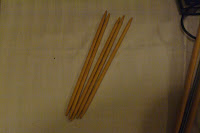 that are knit in the round. They are just sticks with points on each side. The most common uses for DPNs are socks and sleeves.
 that are knit in the round. They are just sticks with points on each side. The most common uses for DPNs are socks and sleeves.
 Knitting has been around for a long time, so there are different ways to measure the diameters of knitting needles. Needles are measured by at least three different systems, the US, the British and the metric. Always make sure that the needle size that a pattern calls for is the system that you think it is. The British system runs in the opposite direction of the US, so using a British Size 3 needle when the pattern called for a US size 3 would not work so well.
Knitting Needles also come in many different materials. The most common are wood/bamboo, metal/aluminum and plastic. I have found that the wood ones are good for yarns that are more slippery, like cotton. The metal ones are good for wool and things that may slide off of the needles.
What is your favorite kind of knitting needle? Have you tried the other interchangeable circular needle sets, if so, how did you like it?
Happy Knitting!
Friday, July 4, 2008
The Joys of Yarn
I really like yarn, if you ask my husband, I have way too much yarn. A while back, he gathered up all of my yarn from my favorite hiding spots around the house and counted all of the skeins he could find. He told me I had about eighty two skeins and he was sure that there were some unaccounted for. He really thought that was a good reason for me not to buy any more yarn for a while. I disagreed, but played along.
 I enjoy shopping for yarn. There are so many possibilities in the isles of the yarn store. So many different colors, thicknesses and fibers. Some of my favorite kinds of yarn are made from Merino wool, Alpaca, Llama, bamboo and cotton. I've never had the pleasure of knitting with silk, but it seems like it would be a nice fiber to create something with. Acrylic and other man made yarns have come a long way since they were first produced. Some are silky, beautiful and have very nice drape. The most important aspect when shopping for yarn is to find a yarn that feels good on your fingers.
Here is a quick guide to the basics of Yarn Weight:
Yarns are for the most part classified according to their thicknesses/diameters. The thinnest yarns are called cobweb and are used to make very fine lace projects. Next is Fingering/sock yarn which is a little thicker and used to make things such as the obious socks and lacy things. Next is the Sport weight yarns, a lot of yarns used to make baby items are Sport weight. Sport and DK weights are very similar with DK (Double Knit) being a little thicker. Worsted Weight yarns are probably the most popular. These yarns aren't so thin that it takes forever to knit something, but they aren't so think that they make the wearer of the knitted item look extra bulky. Bulky weight yarns can be used to items such as blankets and scarfs. The major advantage to knitting with bulky weight yarns is that the project grows very quickly.
If you are looking for An inexpensive yarn that is reliably available in many craft stores, I would suggest Lion Brand Wool-Ease. This yarn comes in different yarn weights, pretty colors. Wool-Ease is very soft and machine washable. I've seen this yarn at stores such as Michael's, Hobby Lobby, Joann's Fabric, and Wal-mart. Wool-Ease is a blend of wool and acrylic and is very soft. This yarn comes in various weights. This is the yarn that was used in my previous videos of the tutorials.
I hope everyone had a happy Independence Day (Fourth of July) and please keep our troups in mind, especially those that are away from their families.
Thursday, June 26, 2008
Knitting Magazines
Knitting Magazines are a great resource. Knitting magazines usually have stories about knit wear designers, a wide variety of patterns, and tutorials on how to do new techniques. Some of the knitting magazine I read are Interweave Knits, Creative Knitting, Knit 'n Style, Knit.1, Knit Simple and Vogue Knitting .
Interweave Knits is published five times a year. Subscribers to this magazine receive four issues in the mail, and can purchase the Holiday issue separately. Each issue has a story about a knitwear designer. There is usually a "Beyond the Basics" Section that explains techniques. Some of the past "Beyond the Basics" sections have included topics such as Cables, Toe-Up Socks, finishing and Gauging. One of these sections included a technique that I hadn't heard of before called Entrelac. The magazine describes Entrelac as "a knitting technique that produces a fabric with a woven appearance." Eunny Jang who is now the editor of Interweave Knits did a wonderful job of describing this technique. Each issue also contains stories about knitwear designers, the history of knitted garments like the tam, and patterns. They have so many patterns that are so appealing, it is hard to make all of the garments that I really like before the next issue comes out. Another part of most issues is a comparison of new yarns on the market.
The other magazines that I mentioned earlier, all have many beautiful patterns, stories about people who knit and articles to improve the reader's knitting skills. They also seem to all have reviews of yarns, books and various other knitting products. I like reading a variety of magazine because they all seem to have different points of view and use different types of yarns for their patterns. It just seems like certain magazines prefer certain yarn companies.
Good luck with finding a magazine that you truly enjoy. I hope that the knitting magazines you read will help you to become a better knitter.
Thursday, June 12, 2008
Congrats to Patrick and Molly and Random Thoughts
I would like to congratulate Patrick and Molly on getting into the Charity School of Nursing. I'm very proud of both of you. Keep up the good work! I can't wait until ya'll are Nurses.
Some questions about Casting On have come up. The reason we cast on is to get stitches on the needles. Most patterns will tell you a number of stitches to cast on. The cast on edge is typically the width of the project.
Another question was “How do you get the stitches off of the needles?” Initially, I said, you leave them on, but I think I was thinking about the question the wrong way. You leave the stitches on the needles until you start the next row. When you start on the knit row, which a tutorial should be coming in a few days, that’s the point where the stitches on the cast on row get dropped off of the needles and the new stitches that you are knitting take their place.
I would like to thank the person who asked this, and please, if you have a question about something not making sense or just a general wondering about something, feel free to contact me. If I don't know the answer, I'll try to find it.
I would also like to thank all of you who are reading this. I hope you are getting something out of this, and I have a some other things planned for the blog. Look for more tutorials, more pictures of finished projects, maybe even restaurant, book and other reviews.
Sorry there aren't any pictures today.
Thanks,
Kelly
Subscribe to:
Posts (Atom)


